The first draft of my Nancy Drew horror mystery novella cover art work arrived yesterday. I’ve made notes and sent them back. Y’all this is so exciting. It looks fabulous and will continue to improve. Can’t wait to share it with y’all in the near future.
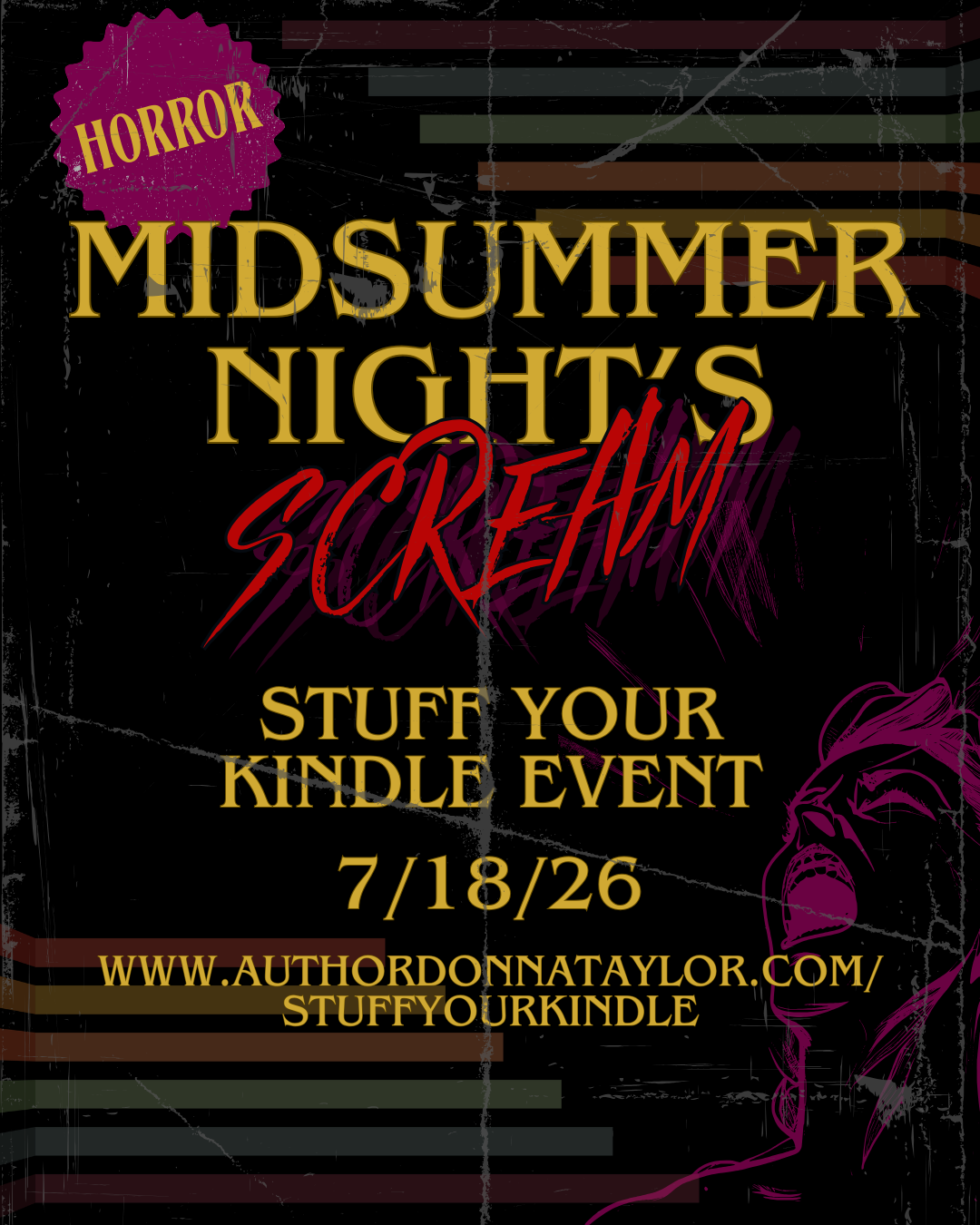
I’ll be participating in the Midsummer Night’s Scream book event by giving away free ebook copies of my short queer YA comedy sci-fi horror story called “Blood Frequnecy.” Mark your calendars for July 18! 🌈 👽
Other authors will be involved in this event as well across Threads and Instagram either with discounted works or free ones.
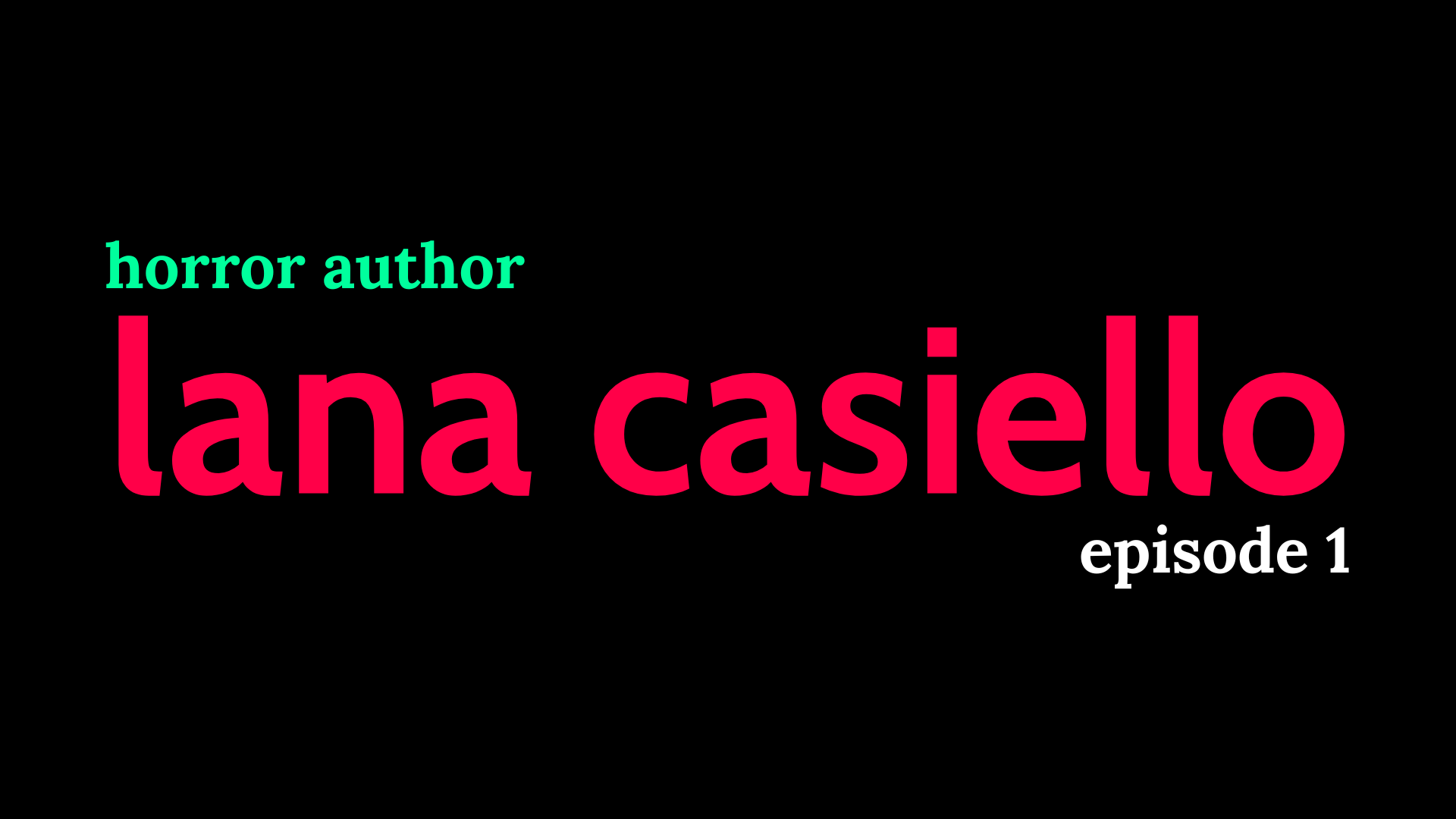
In the second Confabulation episode with horror author Lana Casiello, we talk some more about Hawaiian colonialism and the plantations in Hawaii. We also delve into Casiello’s stories and writing.
Be sure to subscribe to my blog to follow along and get the latest updates on Confabulation episodes. Each episode is also uploaded to my Instagram and Facebook accounts, if you want to follow along there as well.
In the third story of my Mercedes Masterson Detective Stories series, Jonah of Olympic, there is a character named Aaron. He’s not a large role, but an important one. He helps move the plot along. And sometimes smaller roles are good for that, I find. It sort of makes them unsuspecting or as if they just can’t help but center themselves in a story that’s not about them. We’ve all met one of those folks.
But the character is fascinating to me for a number of reasons, one reason in particular is extra interesting to me personally, and it’s something I hadn’t talked about yet and I’m not sure if readers have picked up on it — though I’m not sure how some could have. But to this end, let’s talk about Aaron…
Aaron, the character
In Jonah of Olympic there is a church called Holy Ghost Fire Temple, and Aaron is a young man who is a member of this church. The church leadership hierarchy has an evangelist at the top, and then his right-hand men, the apostles, right below him. Aaron manages a motel in the small town and is zealous and eager for the preacher’s affections. He wants to be an apostle and be counted among the most faithful.
Several readers have confided in me that he is the type of character they’ve known before, especially those of us who used to be or maybe still are in a Christian church. There’s always those young men that are way too zealous and desperately trying to rise through the ranks and always looking for affirmation from church leaders who they adore with way too much adoration. This is who Aaron is.
I try to avoid saying who a character is in terms of good or bad, or what have you, when it’s a character I wrote, because readers may differ on that and it’s fine. What I will say, is I don’t necessarily view him or people like him as bad people, but they can be dangerous if things don’t quite go the way their faith leads them to believe it should. Their faith is super strong, but to a fault in that it blinds them to reason, and that can be dangerous.
In the story, Aaron is a chosen name by himself. We never learn his previous name. All the members who join the church have to pick a biblical name as they begin their new lives. Aaron is the brother of Moses in the bible. He is regarded as a good public speaker whom God suggests Moses use when he tells God he’s no good at public speaking while standing before the burning bush. My character choosing Aaron as his new name is a projection of his ambitions — he wants to rise through the ranks and stand at the side of their church leader, the preacher, and be his voice — just as Aaron was a voice for Moses.
Aaron was a fascinating character to write. And diving into him each time I got to write him was a fun exercise in psychology and spirituality.
But, there’s something else about Aaron that’s interesting to me and I may have subconsciously explored him in ways I’m not even sure of yet.
I hate the name Aaron
My middle name is Aaron. I seldom use the name or mention this fact, because it’s always bugged me ever since I was a kid. I appreciated the meaning of the choice, my parents naming me after Aaron of the bible. But there was just always something off-putting to me about that name. To this day, I’m not sure what it is for sure. But when I look at that name, I do not see my name. I see something else and it bugs me that it’s supposedly my name. So I’ve mostly learned to ignore the existence of Aaron between my first and last names.
I do recall vague memories of looking at the name when I was first learning to spell it and just being so annoyed by how it looked on paper in my sloppy kid’s handwriting. The two As back-to-back also annoyed me. I recall thinking about how the name verbally was a name that could be either masculine or feminine, but on paper with those two As, it was clearly masculine. And I do remember that bugging me. I can’t say why, though it may have been an early indication of me being genderqueer. The fact the name is gender neutral audibly, but when you spell it Aaron on paper it is indisputably masculine. Erin, of course, being the feminine spelling. And my spelling of the name was the masculine variant — Aaron.
It’s so fascinating to think about how annoyed I was seeing that name when I wrote it down the first few times. I was instantly appalled by it. And as a kid, the only thing that tended to appall me instantly was seeing injustice. Like, when some kids bullied another kid. That was the quickest way to piss me off as a kid.
But writing Aaron on paper for the first time, and knowing it was my name, that pissed me off so hard.
But what does this have to do with my fictional character Aaron? I don’t know. When I was writing the character, I wasn’t focused on the name being my middle name. You have to keep in mind, when I write that name it doesn’t even register as my name. I was focused on writing an interesting character who saw himself as the potential metaphorical brother of Moses. A gifted speaker and leader alongside his spiritual leader who he adored. I wasn’t thinking about myself at all while writing the character.
Now though? Now I’m wondering. Was I subconsciously getting some deep-rooted feelings off my chest about the name Aaron? It looks like I’m going to have to re-read my own story and decipher the hell out of that character, because I may have been writing about myself, too.
Conclusion
I don’t think I’ve ever talked this much about my feelings concerning the name Aaron with anyone. So this is like therapy in the open. It’s also worth noting that I only hate the name Aaron as it pertains to me. If your name is Aaron, that’s ok, I forgive you. I mean, it doesn’t bother me. It’s just this notion that the name is mine when it really doesn’t feel right at all.
If you’ve read Jonah of Olympic, what did you think of Aaron? Give me your literary critique of Aaron, the character, in the comments. If you’ve not read the book yet, you can find it on the publications page.
What about you? Do you have a middle name that irks you? Do you love your middle name? What do you think my kid brain was doing when it saw the name Aaron on paper? Sound off.
Here is the first of three episodes where I interviewed horror author Lana Casiello. Originally uploaded in full to YouTube, I’ve decided to bring my writing world interview series, Confabulation, to other places. I’ve also decided I’ll be breaking these interviews into episodes moving forward.
In this first episode, Lana and I discuss colonialism in Hawaii and her Hawaiian heritage. More to come in the next episodes, so stay tuned. Follow the blog if you like this Confabulation series. I interview authors, publishers, and other writerly types.
Soon I will be headed to go record the vocals to this original rock ‘n’ roll song for my Nancy Drew horror mystery story. I’m gonna have a blast and I hope this song is something y’all enjoy hearing alongside the novella itself when it drops. Gonna try and make a point to get some pics or videos to share from the recording session.
I have to harmonize with myself at least twice during the recording session — the chorus will have a lot of my voice. 😂
I always enjoy learning about what tools others use in their writing process. And I always enjoy learning new ones for myself, if it helps me get better at my own process. Today I’m going to share some tools I use in my writing and ask that you jump into the comments and share the apps and tools you use to write your fiction, newsletters, or blog posts.
1. Apple Notes for taking notes
I’ve been using Apple Notes for over a year to take writing notes, especially for fiction. I find it’s more than capable and a delight to use because it’s so minimal in design.
Ways I use Notes in fiction:
character sketches
cast lists
plot notes
research notes
jotting down dialogue
publishing notes
Price: 100% free, but for Apple devices only.
2. Apple Pages for drafting
For the same amount of time I’ve been using Apple Notes, I’ve also been using Apple Pages. I had been getting tired of Microsoft Word’s AI bloat and wanting to try something that could maybe replace it. And yes, I’ve tried many other ones, including most of the open source ones. I find Pages is nice to draft fiction and newsletters in. It has a mostly minimal design, like Notes, which makes the drafting period enjoyable. I have yet to fully commit to it as a formatting replacement when it comes to ebooks and paperbacks, and still jump to Word for that. I may start playing with that again soon, and see if I can’t get it to replace Word for that as well.
What I use Pages for:
draft my email newsletters
draft short stories and novellas, but haven’t written a novel in it yet
Price: Free, but like Notes, it’s tied to Apple devices for the most part. There is a Cloud version on the web that is similar to Google Docs, though.
3. TickTick for story tracking
TickTick is a productivity app. You can make task lists and kanban boards, use a pomodoro timer, make countdowns and more. I like using a kanband board to track the progress of a story, especially when said story is a longer piece like a novella or novel. I’m a very visual person, so having a visual element to track progress helps me visualize where things are and how much more work needs to be done. Below is a screenshot of my sketchy kanban board for the story The Book of Jude as an example, because it’s hard to describe it in text. What you can’t see, because it wouldn’t fit in the screenshot and there were spoilers, is there is one more column to the left of Draft 1 called Tasks. That is just a generic list for miscellaneous tasks. This is all drag-and-drop and you just move the chapters around the board between columns as you progress. Grace is my editor, fyi.
Screenshot of my kanban board for The Book of Jude in the TickTick app.
You may be wondering why I don’t just use Apple Reminders, because it too can handle kanban boards and is completely free. I did try it, but I’m persnickety when it comes to how a card/task is handled. If I can’t open a task in a new window and set it side-by-side with my writing space on my computer, I get frustrated. Apple Reminders tasks just open in a pop-up on desktop and if you click off of it, they go away. It’s not very helpful to how I write and there is no ability to add comments to tasks, which can be useful. If you don’t mind these missing features, then Reminders may be enough for you. I do use a Reminders kanban board as a weekly planner, though.
What I use TickTick for:
track draft progress
track chapter edits, revisions, continuity, and more
random task management for the writing process
Price: Free with limitations, or $3.99/month to unlock more.
4. A good old fashioned whiteboard
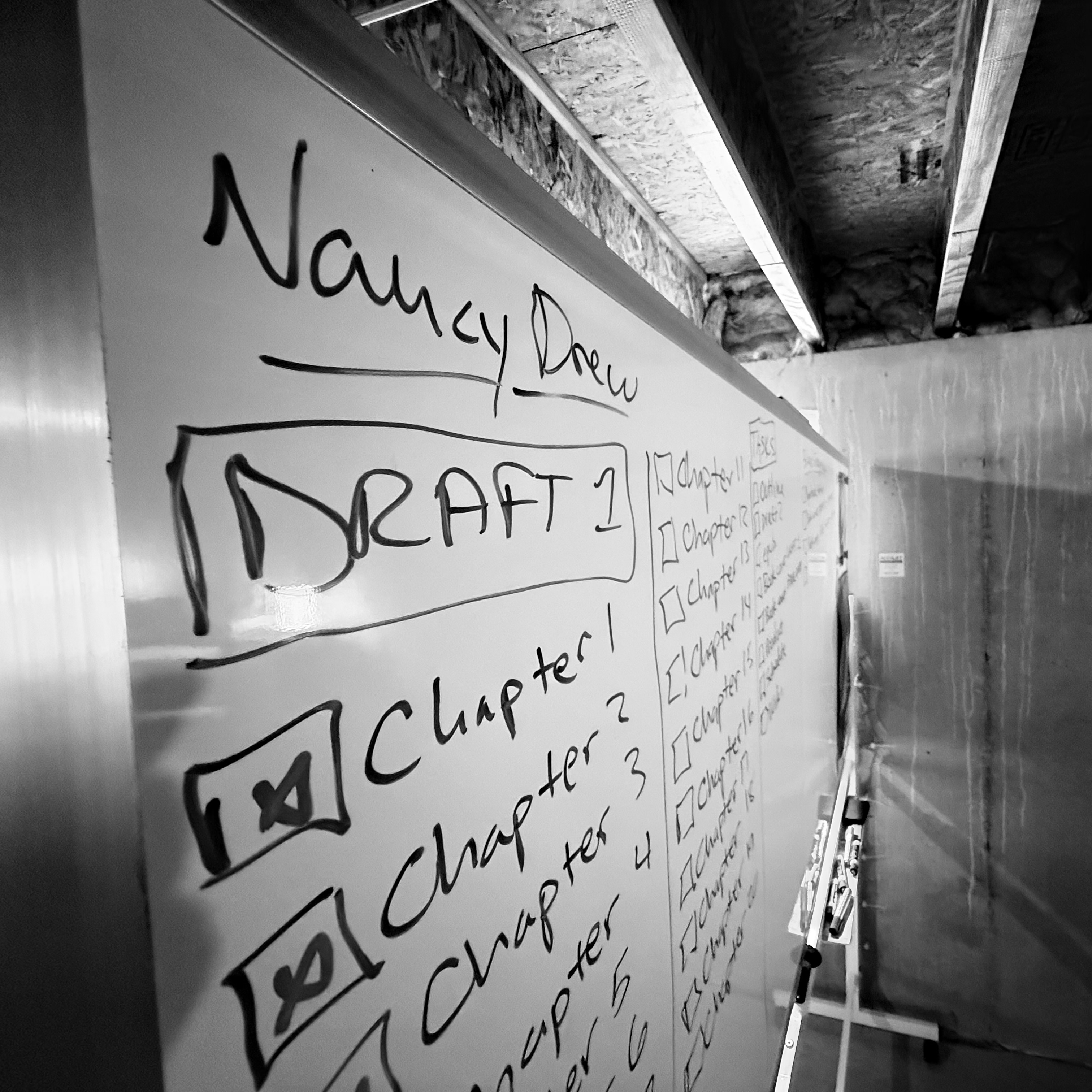
I can’t recall who it was but a fellow author online mentioned having a whiteboard a while back, and that blew my mind. I loved the idea of using a whiteboard in the writing process. I have a two-sided, very large, and on wheels whiteboard in my writing space. When I was still in college, I was using one side for school work and the other for fiction and newsletter stuff. Here’s how it looks:
There are multiple benefits to using a whiteboard. It creates a visual, which I like, and it forces me to get off my butt and move around. Writing is a very seated work. This forces me to get up and walk over to the whiteboard from time to time. A lot of the tasks I have on the board are also on my TickTick kanban board, but not all of them are. I also put magnets, photos, and other things on the board to help bring inspiration to my writing space.
What I use my whiteboard for:
task management for fiction, newsletters, publishing, blog posts, and more
I draw doodles sometimes to get me off my butt
sticking magnets, old actor candid or publicity photos (Veronica Lake and Lauren Bacall), and a movie poster of X-Files: Fight the Future on it for inspiration
Price: Depends on what whiteboard you want to get. Just shop around and consider your options, how you want to use it, and how much space you have to work with. I work in a basement with a lot of floor space, so I was able to go big and did not go home.
Conclusion
What about you? What tools do you use to write your fiction, newsletters, or blog posts with? Please sound off in the comments. Did any of these tools sound good to you? Are you going to try one? It’s worth noting kanban is a productivity method that can be used in many different apps or even on a whiteboard, you don’t have to use TickTick to do it.
I use other tools as well, but I wanted to keep this relatively short. I’ll post about those other tools in a future blog post.
I’ve added this blog to the fediverse. You can now follow this blog using your Mastodon or other like-minded fediverse account. Use the follow button below to follow along with new blog posts from this site. I’ll be writing about movies, horror, writing, random observations, sharing goofy videos, dancing, and sharing my writing as well. I write dark fiction which for me includes horror, YA horror, sci-fi, crime/thriller, noir, and in the near future a Nancy Drew horror mystery novella.
You can comment and react to blog posts on the fediverse, and I should be able to interact back with you. It’s exciting to take this blog to the fediverse. Please comment and check out the other blog posts I’ve previously published here.
When it comes to writing, I’ve been in a state of working on stories since I was a teenager. It’s hard to even imagine not telling stories at this point. My mind leans into telling stories. Even when I’m not currently writing one, my mind will continue to come up with ideas, and then I make notes, so I can get to it later.
When I travel somewhere new, my brain starts envisioning how a story could be told there.
My mind is stories.
Any other authors have brains that work like this?
I think for me it’s just that I can be like, “Hey, I think I’ll do this thing,” and then just do it.
At the start of this year, I discovered Nancy Drew entered the public domain, had ideas for stories and put the stories I was writing on hold to work on a Nancy Drew story. And that’s fine! — and no one is telling me I can’t. And I’m having the time of my life with it.
What about you? What do you love most about being an indie author? Sound off in the comments.